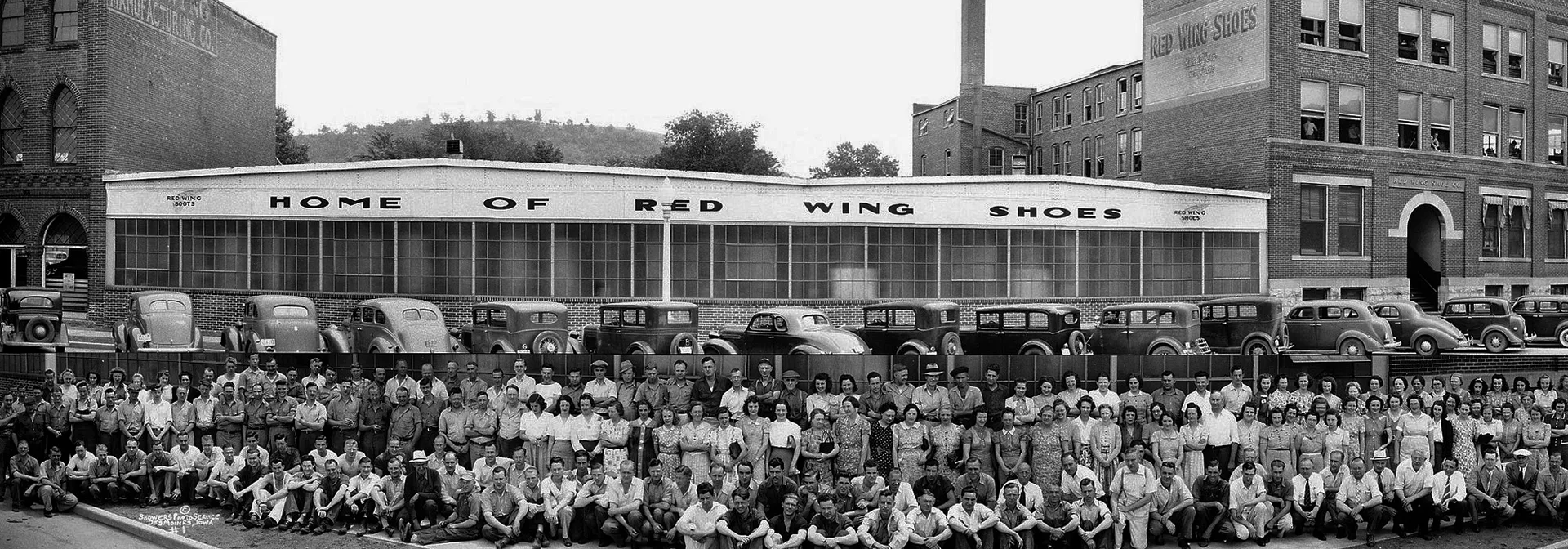
Red Wing kept the factory in Red Wing, Minnesota. You can feel it.
When every competitor moved production overseas, Red Wing stayed. Not out of nostalgia — out of the belief that the boots they made in that factory were worth what they cost to make there.
Red Wing Shoe Company has been making boots in Red Wing, Minnesota since 1905. The city is named for a Dakota leader, sits on the Mississippi River, and has a population of about sixteen thousand people. A significant portion of those people either work for Red Wing or have a family member who does. This is not a marketing story. It is simply the situation.
The boots are expensive for work boots. They are not expensive for what they are. The leather is tanned at the S.B. Foot Tanning Company, which Red Wing acquired in 1987 and which sits a few miles from the main factory. The hide goes in, the leather comes out, the boots get made, the product ships. The supply chain has geography. Most supply chains don’t.
What staying actually costs
Red Wing could make its boots cheaper elsewhere. The calculation was made and the decision taken not to, sometime in the mid-twentieth century when every other American work boot manufacturer was moving production to Mexico or Asia. Red Wing stayed because the people who ran the company believed that the quality of the boot — the leather, the construction, the last — was inseparable from where and how it was made.
That turned out to be correct. The boots hold their shape because the leather is good. The leather is good because it’s tanned properly, in a facility with decades of institutional knowledge, by people who care whether it’s right. You cannot fully replicate that by moving the process somewhere cheaper and hiring differently.
The price of a Red Wing boot is the honest price of making it that way. The companies that charge less have made a different set of decisions, and those decisions are visible in the product.
A boot that can be resoled, reconditioned, and worn for twenty years is not an expensive boot. It’s a cheap boot amortized correctly.
What you’re actually buying
Red Wing’s heritage line — the Iron Ranger, the Blacksmith, the Moc Toe — can be rebuilt. The company runs a network of stores where they will recondition your boots: replace the sole, recondition the leather, fix whatever has gone wrong. A pair of Red Wings that gets this treatment every few years can last a working lifetime.
This is the thing people mean when they talk about buying fewer things of better quality. Not as an aesthetic position or a way of signaling taste, but as a practical calculation about what things cost over time, and what it means to own something rather than just use it until it fails.