The Rules Are the Product
Teenage Engineering didn't build a design language by having good taste. They built it by choosing fewer colors, visible screws, and no undo — then holding the line when it cost them.
Jesper Kouthoofd was fifteen when he started designing record sleeves. Not as a hobby, as a calling. The kind of early obsession that either burns out or calcifies into a genuine point of view. In his case, it calcified. Forty years later, his Stockholm studio Teenage Engineering makes synthesizers and audio tools that are instantly recognizable from across a room, not because they’re loud but because they’re restrained in exactly the same way every time. That consistency isn’t branding. It’s discipline.
Kouthoofd founded Teenage Engineering in 2005 with David Eriksson, Jens Rudberg, and David Möllerstedt, the latter coming from the audio department at EA DICE. The four of them had run Netbabyworld together, a games company, which matters more than it sounds. Games are experience-first. You don’t read the manual; you play until you understand. That instinct, design as something you discover by using, not by studying, runs through every Teenage Engineering product since.
The Forty-Color Limit
Before Kouthoofd designs anything, he narrows the field. The studio works from RAL, an industrial color standard developed in Germany in 1927 that contains roughly forty colors. Not Pantone’s thousands. Not a custom palette. Forty.
He’s explained the reasoning plainly: Pantone gives you so many choices that selecting a color takes weeks. RAL gives you two blues. The constraint isn’t poverty, it’s efficiency. And efficiency in constraints produces, eventually, a kind of freedom. His formulation is worth quoting directly: “I stick to rules and try to understand them, because then I can become free again.”
This is not the language of someone who stumbled into minimalism because it was fashionable. It’s the language of someone who has thought carefully about what systems actually do to creativity. The RAL palette, the German industrial standards, the visible hardware, these are a chosen vocabulary. Once the vocabulary is set, Kouthoofd can think about what to say instead of how to say it.
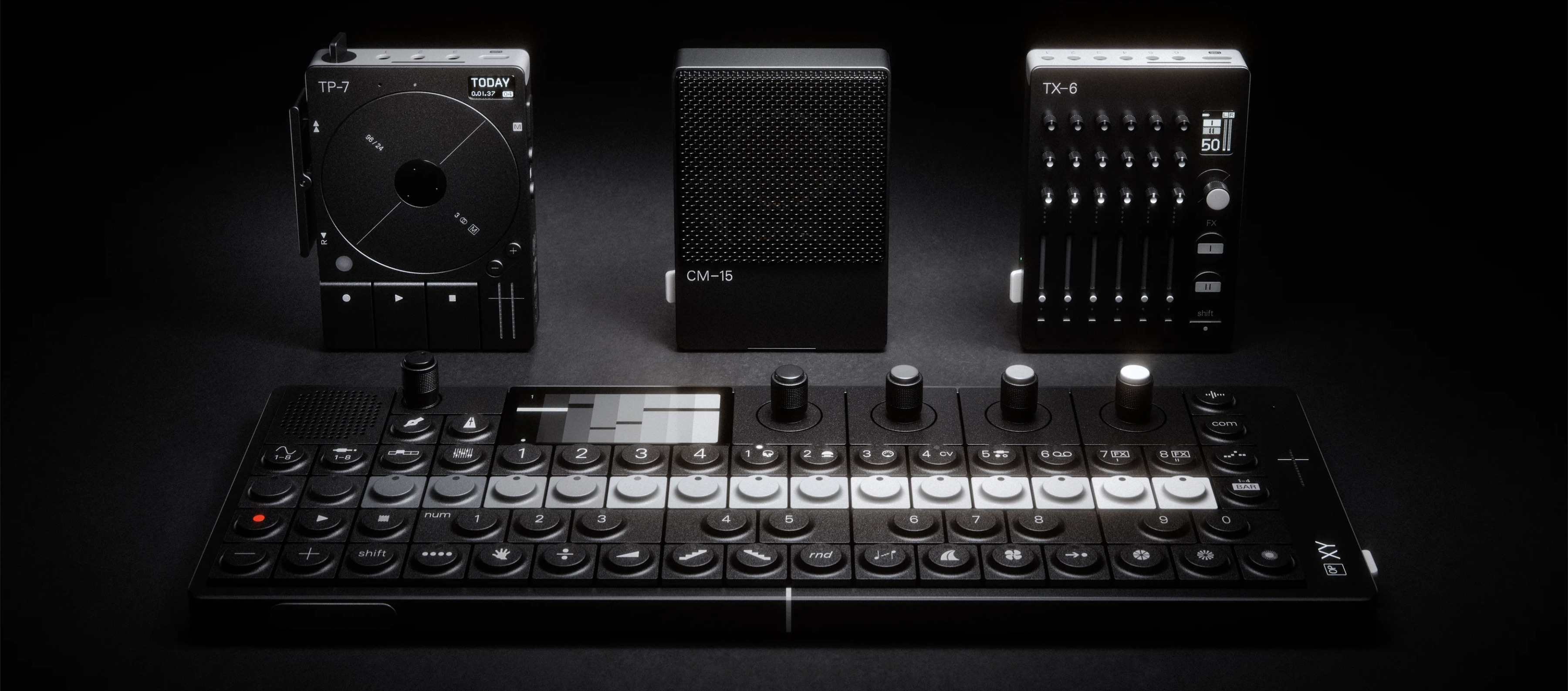
The OP-1 synthesizer, their flagship, arrived in 2011 after years of development and sits at the center of this philosophy. It contains a synthesizer, sampler, drum machine, sequencer, mixer, and four-track recorder. The entire interface is four rotary encoders and a small screen. No hidden menus, no touch surface, no software companion to make it make sense. What you see is what there is. The smallness, the toylike weight, both were criticized. But the criticism missed the point. Kouthoofd was inspired by Japanese synthesizers from the 1980s, the Casio VL-Tone and SK-1, instruments that forced players to work within tight parameters and came out the other side sounding like themselves. He has said that limitation is the OP-1’s biggest feature. That’s not spin. It’s a design decision with consequences.
No Undo
The costly decision is the product, because the costly decision is where the toil lives.
When Teenage Engineering released the OP-1 Field in 2022, they included one choice that generated more argument than anything else: no undo function. You record something, you’re committed. Mess it up, live with it or start over.
They didn’t forget undo. They removed it on purpose, explicitly to mirror the experience of recording on a four-track tape machine, a format where mistakes become texture, where commitment shapes the performance. Plenty of users found this maddening. That’s a legitimate response. But it’s also, structurally, exactly what constraint-based design is supposed to do: force a relationship between the person and the tool that a frictionless environment wouldn’t allow.
The screws are visible on every Teenage Engineering device. The seams don’t hide. The circuit board on the Pocket Operators, their sub-$100 line of mini instruments, evocative of pocket calculators and Nintendo’s Game & Watch, is exposed by default, no case. You can see what’s holding everything together. This isn’t an aesthetic choice in the decorative sense. It’s an argument: that understanding how something is made is part of understanding what it does.
The Pocket Operators also came with something unusual for a $50 piece of gear, genuine personality. Kouthoofd describes the design influence as coming from post-war Germany and the industrial culture near the Italian border, “a certain type of philosophy” around communication and design. That sounds abstract until you hold one. Then it makes sense. There’s something sturdy and considered in even the cheapest thing they make.
Why It Matters
The tools you use shape what you make. A DAW with unlimited tracks and infinite undo produces music that sounds like it was made with unlimited tracks and infinite undo, layered, safe, hard to finish. An OP-1 with no undo and four knobs produces music that sounds like a decision was made and honored.
Teenage Engineering’s design philosophy is ultimately an argument about creative life: that constraint isn’t deprivation, it’s direction. That visible screws are honest. That a forty-color palette produces clearer thinking than a thousand-color one. These aren’t comfortable arguments, they cost the studio sales, generate criticism, and require holding a position when it would be easier to add a feature.
What they make isn’t for everyone. The price is high, the interface is small, and the philosophy is occasionally unforgiving. But for the person who finds that a tool with real limits produces their best work, who discovers that commitment sounds better than revision, these objects are not a luxury. They’re the right instrument for the job.